
TL;DR
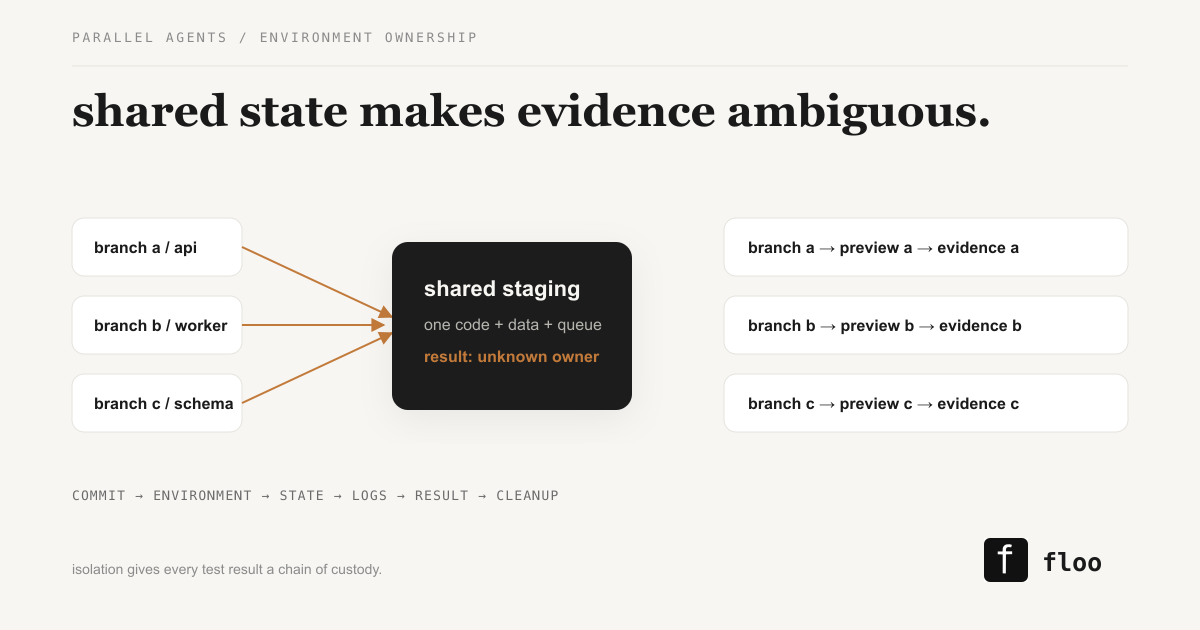
Shared staging breaks under parallel agent work because multiple proposed changes mutate the same services, data, queues, configuration, and runtime evidence. A test result no longer belongs to one change.
- Concurrency turns staging into a race. One branch can replace the code or schema while another branch is still testing.
- Shared state destroys attribution. A row, cache key, job, email, or log line may belong to any active change.
- Manual fixes create a second source of truth. A staging-only tweak can make the test pass without proving the repository is deployable.
- Branch-scoped previews give every change an owner. Code, routes, managed state, logs, and cleanup can be tied to one commit or pull request.
- Shared staging can remain a final integration surface. It should not be the first place every agent change becomes real.
Shared staging assumes serialization.
A developer deploys a branch, tests it, and leaves the environment in a recognizable state for the next person. The process is imperfect, but a small team can coordinate around it because the number of concurrent changes is low and the people involved can ask each other what happened.
Agents change that operating assumption. They can produce several full-stack changes at once, keep working while builds run, and retry without waiting for a shared calendar. The code-generation bottleneck falls away. A single mutable staging environment becomes the serialization point for the whole team.
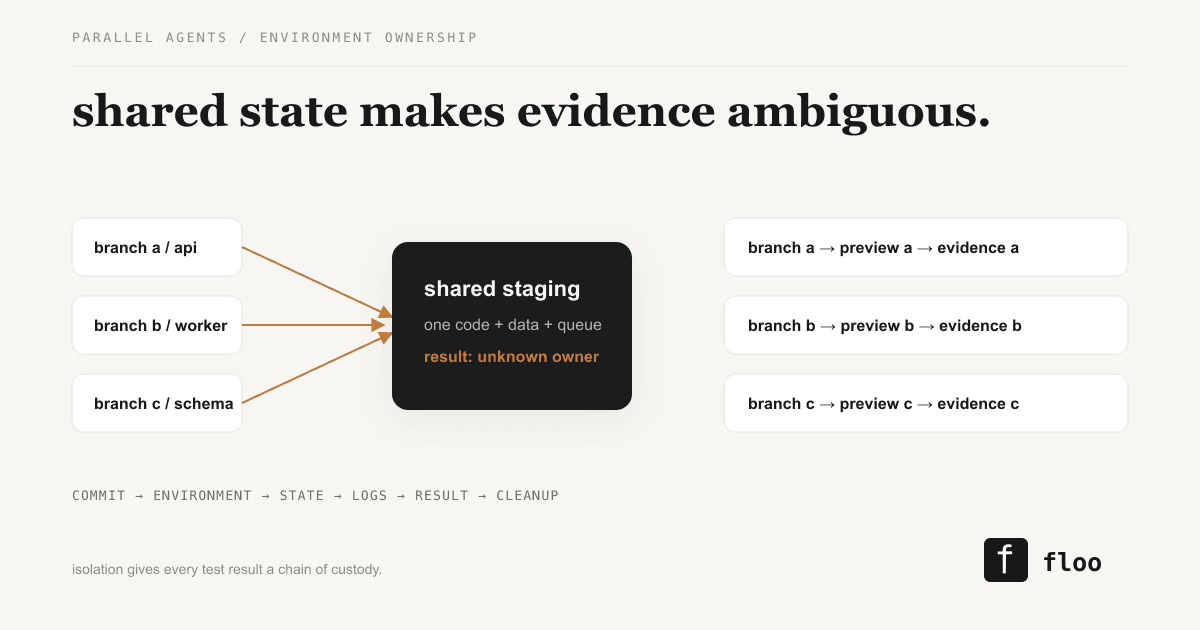
Shared staging answers “what is running now?” A branch preview answers “did this change work?”
The problem is not uptime. it is attribution
A healthy staging environment can still return unusable evidence.
Suppose three agents are working in parallel:
- one changes the API contract for imports;
- one adds a worker and queue retry policy;
- one changes the database schema used by both.
The first agent deploys and starts an integration test. The third deploys a migration before that test completes. The second pushes a worker with a different message shape. The import now fails.
Which change caused it?
The answer cannot be recovered from the final staging state alone. The failing request crossed code, schema, and worker versions that may never exist together in a reviewed commit. Retrying after the latest deploy may pass, but that does not validate any earlier branch.
This is the central failure of shared staging under concurrency: the environment has current state, but the evidence has no stable owner.
Every shared dependency becomes a collision surface
Code overwrites are the visible collision. Mutable dependencies create the harder failures.
Databases
One branch adds a nullable column. Another makes it required. A third backfills the same rows. The shared database ends up ahead of some application versions and behind others.
Tests also contaminate one another. A unique email inserted by one run breaks another. A cleanup step deletes a row a different agent is inspecting. Sequence values, timestamps, and old records make retries non-deterministic.
The database may remain internally consistent while no branch can reproduce the observed state.
Queues and workers
A staging queue rarely knows which pull request owns a message. A new producer can emit a payload that an old worker cannot parse. A retry from yesterday can wake up during today's test. Two branches can consume the same job or apply different retry policies to it.
The test says “the job disappeared.” It does not say which worker processed it or which code path acknowledged it.
Caches
Cache keys often omit branch identity because production does not need it. In shared staging, one branch can populate a value using a new serialization format while another reads it with old code. A cache flush makes the test pass, but removes the evidence needed to understand the incompatibility.
Cron and scheduled work
A shared scheduler runs independently of the branch currently under test. Cleanup, billing, notification, and reconciliation jobs can mutate state halfway through an agent's verification sequence.
Disabling cron in staging avoids the collision by deleting part of the production shape. Leaving it enabled makes results time-dependent. Per-change isolation is the cleaner contract.
Email, webhooks, and external systems
Several branches may use the same test inbox, webhook endpoint, payment sandbox, or third-party tenant. Correlation identifiers help, but they do not isolate global settings, rate limits, or irreversible sandbox actions.
External systems need explicit partitioning, fakes, or human boundaries for consequential actions. A preview platform can isolate what it owns. It cannot make an unpartitioned third party branch-aware by declaration.
Shared configuration creates invisible drift
Staging often contains years of manual repairs:
- an environment variable added in a dashboard;
- a route changed temporarily and never reverted;
- a secret with a different name from production;
- a database migration applied by hand;
- a worker disabled after an incident;
- a test integration pointed at a convenient shared account.
Those edits make staging useful as a team appliance. They also make it a poor proof that the repository can construct the intended application.
An agent sees the code and the platform output. It may not know that a human fixed the environment six months ago. If the branch passes only because staging contains hidden state, the agent learns the wrong deployment contract.
This is why a branch-scoped environment should be created from reviewable desired state. Secrets remain outside git, but the topology, routes, policy, migration path, and managed attachments should be attributable to the proposed change.
Coordination does not scale as a fix
Teams usually respond to staging collisions with process:
- reserve a time slot;
- post “using staging” in chat;
- add a deployment lock;
- create a second staging environment;
- reset the database before testing;
- ask everyone whether it is safe to deploy.
These controls restore serialization. They do not restore parallelism.
A deployment lock may be appropriate for one final integration environment. It is a poor default for the first running test of every agent change. The team has paid for parallel code production, then rebuilt a human queue around its only realistic environment.
The failure becomes sharper in a software factory. The factory needs to observe a signal, propose a change, run it, verify it, and continue. If every loop waits for a shared staging lease, deployment infrastructure becomes the factory's throughput ceiling.
Isolation restores a chain of custody
A branch-scoped preview gives the proposed change a stable identity across the running system.
The useful chain is:
commit → deploy → environment → services → routes → managed state → logs → test result → teardown
Every link should be inspectable. If the API test fails, the agent can identify the API revision, worker revision, database branch, and logs belonging to the same preview. A retry updates that preview rather than replacing the environment underneath another branch.
This is more than a unique frontend URL. The preview needs the application's production shape and separate mutable state. Otherwise, the unique URL is still a doorway into shared staging.
Current platform products reflect this shift. Railway describes PR environments as isolated, temporary copies of a base environment containing services, networking, and variables. Its standard PR environment is scoped to one pull request. Render explicitly frames preview environments as an answer to the isolation limits of one shared staging environment, then creates new service and datastore instances per pull request. Its datastore instances do not copy existing data by default.
The common idea is ownership. A proposed change gets infrastructure that can be attributed to it and removed with it.
An isolation checklist
Before calling an environment branch-scoped, test the boundaries that commonly leak:
- Code: Are every service and job revision tied to the same source change?
- Routing: Can any preview request fall through to a shared development or staging service?
- Database: Does the change receive state it can migrate and reset without affecting another branch?
- Queue and cache: Are messages, consumers, keys, and flush operations scoped to the preview?
- Storage: Are uploaded and deleted objects owned by the preview?
- Configuration: Can the environment be reconstructed without a manual staging-only edit?
- Observability: Do logs and diagnostics name the preview, service, deploy, and commit?
- Cleanup: Can the platform enumerate and remove exactly what this preview created?
- External systems: Which dependencies remain shared, and what test partition or gate contains them?
The answer does not have to be “everything is duplicated.” Isolation can use schemas, namespaces, branches, prefixes, and scoped credentials. The test is whether one preview can mutate its resources without changing another preview's result.
Shared staging still has a job
Per-change previews do not eliminate every persistent environment.
Shared staging can still serve as:
- a final integration surface after individual changes pass;
- a place to test organization-wide configuration or shared external sandboxes;
- a stable target for exploratory testing and product review;
- a rehearsal environment for release procedures that intentionally combine several changes;
- a compatibility checkpoint across independently deployed repositories.
Its meaning changes. Shared staging becomes one deliberate phase, not the only realistic place code can run.
The key is to stop asking it to answer a question it cannot answer under concurrency. Staging can show how an integrated candidate behaves. It cannot reliably prove which independent branch caused a result while several branches are mutating it.
Where floo fits
floo previews are branch-scoped environments with stable preview identity. The source comes from the connected repository. Multi-service routes remain inside the preview. floo-managed Postgres, Redis, and storage receive preview-owned resources and credentials rather than inherited development credentials.
If managed-resource isolation cannot be provisioned, floo blocks the preview. It does not silently reconnect the change to development state. The preview can start empty, run a seed policy, or clone supported managed data from development. None of those modes claims to copy production data.
The lifecycle is attributable and bounded. Structured preview output identifies the source branch, deploy, URLs, expiry, and managed-resource branches. Reset targets only the selected preview resource. Closing the pull request or reaching the preview TTL triggers teardown of the environment and its tracked resources.
That gives agents the property shared staging loses first: a result with one owner.
Parallel agents do not require the team to abandon staging. They require the team to stop using shared staging as a mutex around every change. Give each branch somewhere real to run, preserve staging for the integration question, and let both environments mean one thing clearly.